Setting a bridge girder is the most critical part of bridge-building operations. It is more than just erecting a prepared piece of girder and setting it on bearings. It requires maintaining a suitable crane operating radius, ensuring adequate stability against collapse, and providing enough boom outreach for proper girder placement.
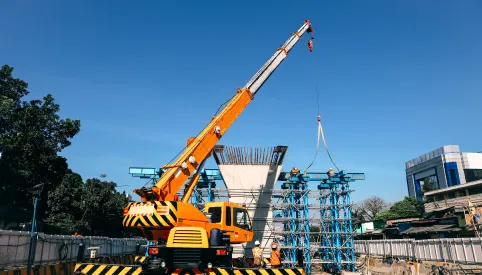
Site conditions can make the operation more demanding. Limited access, uneven ground, nearby structures, traffic movement and restricted working space can all affect crane positioning. That is why equipment selection must be based on actual lifting conditions, not girder weight alone.
Asian Crane Services is your go-to source for the supply of mobile cranes to the construction and infrastructure sectors. Our selection of telescopic cranes comes in several sizes and capacities, giving project managers ample choice. You can choose mobile cranes based on required load capacity, reach requirements, site access, and environmental conditions.
A bridge girder may be within a crane's capacity; however, it may still be unsuitable for certain lifts, as the capacity depends on factors such as radius, boom length, counterweight, and outrigger configuration. It is recommended to review the complete lifting plan prior to selecting the appropriate crane.
Key factors include:
A telescopic crane rental can be readily adapted for different sections of the bridge. This allows the contractor to use different cranes for different erection phases, rather than one setup for all lifting.
A hydraulic telescopic crane is built with hydraulically operated telescope which could be expanded or shortened for your desired span required for the lifting of heavy loads. This is useful for lifting when the crane can't be positioned directly next to the final spot.
In the process of installing a girder, the crane should be in a condition to:
The crane must operate within the manufacturer's load chart during movement, as radius or boom length changes influence capacity. When evaluating a hydraulic telescopic crane, consider the entire lifting path, not just maximum capacity.
A crane's working radius is a key thing in its selection, and it refers to how far the load is placed from the centre. As the radius increases, a crane's load-lifting capacity decreases, and boom extension plays an important role when handling loads farther from the bridge.
| Crane Selection Factor | Why It Matters During Girder Installation |
|---|---|
| Girder weight | Determines the required lifting capacity |
| Working radius | Influences the available capacity |
| Boom length | Determines required reach and affects load-chart limits |
| Outrigger configuration | Supports crane stability during lifting |
| Ground condition | Determines whether the setup area can safely support the crane |
| Rigging arrangement | Influences load distribution and girder control |
| Clearance | Prevents contact with structures and obstructions |
| Site access | Determines whether the selected crane can reach the work zone |
Include lifting accessories and rigging in load calculations. Don't consider crane rated capacity as the actual payload without examining configuration and load setup.
Bridge construction sites change as work progresses, so crane positions available at one stage may not be available later. Access is key; the chosen telescopic crane rental must reach the setup area without disrupting other activities.
Before mobilisation, the project team should review:
Ground preparation is critical because outriggers can exert substantial loads on the supporting surface. Where required, suitable mats or plates can help distribute these loads and provide a stable crane setup.
Install the girder plan before the crane arrives. The lifting plan should detail how the girder moves throughout the entire operation, not just final placement.
A typical assessment covers:
Compare the manufacturer's load chart with the planned setup because changes in boom length, radius, counterweight, or outrigger arrangement can change the crane's capacity. Pre-lift planning is essential when using a hydraulic telescopic crane for heavy bridge parts.
A telescopic boom lift performs a different function from a crane. It is an aerial work platform intended to provide elevated access for personnel and tools. It should not be treated as an alternative to a crane for lifting heavy bridge girders.
A telescopic boom lift may support tasks such as:
This distinction is key in bridge projects. Teams choose cranes for lifting and telescopic boom lifts for access. Using each machine as intended improves control over lifting and access.
Bridge construction projects do not always require permanent ownership of heavy lifting equipment. Some cranes may only be needed during specific erection stages.
In these situations, telescopic crane rental provides access to the required equipment without a long-term fleet commitment.
Rental can be particularly useful when:
The rental decision should remain primarily technical. Contractors need to provide precise project details—such as girder weight, dimensions, lifting radius, height requirements, access points, and lifting setup—before choosing a crane.
Planning is one of the most important parts of installing bridge girders, and it involves not only selecting the right crane but also implementing the plan carefully. Machinery should handle the required radius without exceeding the manufacturer's permitted configuration.
A telescopic crane rental gives contractors flexibility when lifting requirements change between project stages. At the same time, a hydraulic telescopic crane can provide the boom reach and configuration flexibility required for different lifting conditions. Telescopic boom lifts can support separate work-at-height activities that require elevated access.
Asian Crane Services offers telescopic crane rental solutions for construction and infrastructure applications, with a range of crane capacities and configurations. Our equipment fleet includes truck-mounted and all-terrain telescopic cranes suited to different lifting requirements.
Asian Crane Services assists with bridge girder installation by evaluating lifting capacity, reach, and site conditions to select the right crane. Contact us to discuss your project and rental needs.
